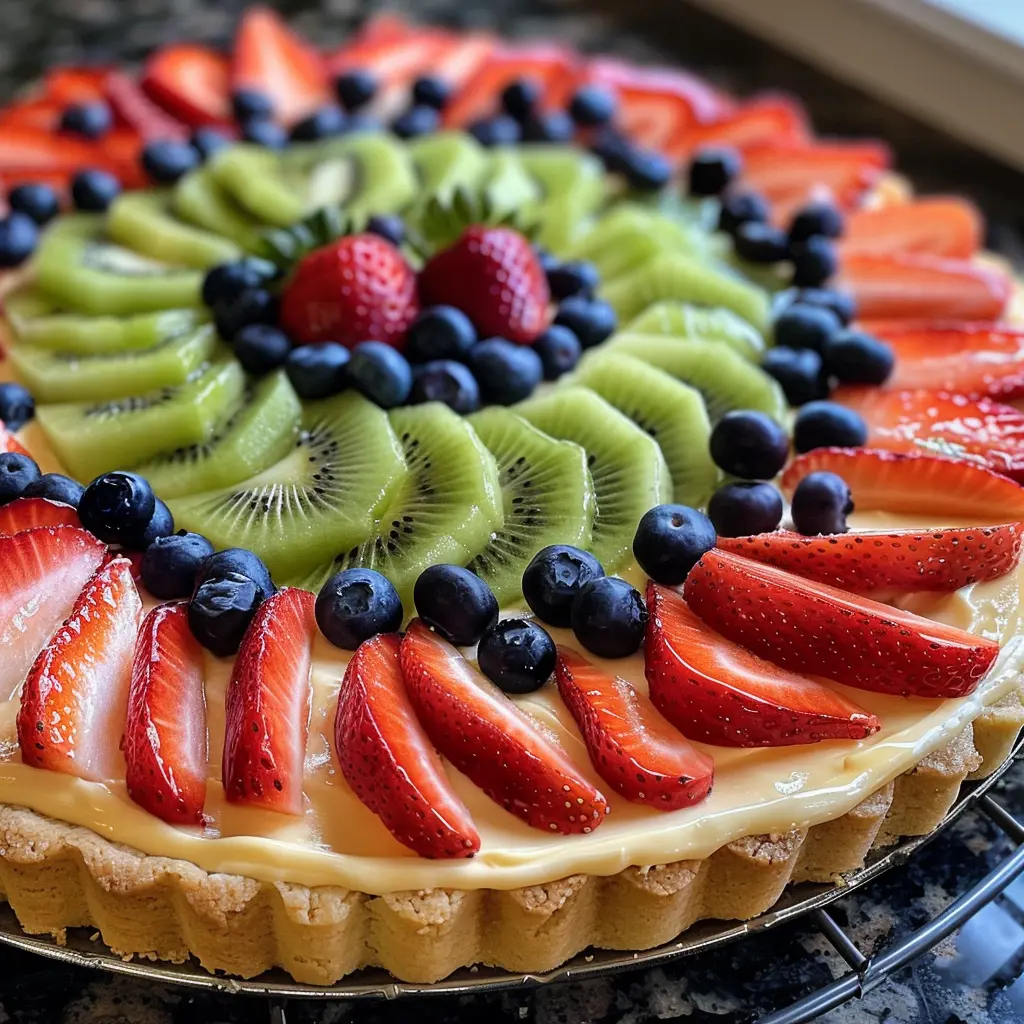
Fruit pizza builds a thick, chewy sugar cookie crust, spreads it with a tangy cream cheese frosting, and covers it in whatever combination of fresh fruit makes it look like the most inviting thing on the dessert table. It’s the kind of recipe that gets pulled out for summer gatherings, holidays, and potlucks — and disappears faster than anything else on the table every single time.
| Detail | Info |
|---|---|
| Prep Time | 25 minutes |
| Chill Time | 20 minutes to 1 day (dough) |
| Cook Time | 19 minutes |
| Cool Time | 45 minutes to 1 hour |
| Total Time | About 2 hours |
| Servings | 12 |
| Difficulty | Easy to Medium |
| Cuisine | American |
Why This Recipe Works
Cornstarch in the cookie dough is the ingredient that most home bakers don’t expect and that makes the biggest difference in the final texture of the crust. Cornstarch interrupts gluten development in the flour and produces a more tender, softer crumb than flour alone. In a sugar cookie crust that needs to hold up to slicing without crumbling and support a layer of cream cheese frosting and fruit, this tenderness is the sweet spot between brittle and dense. It’s the same principle behind soft-batch cookies — a small amount of starch changes the texture dramatically.
Chilling the dough for at least 20 minutes before pressing it into the pan is not just about convenience. Cookie dough that’s chilled before baking spreads less in the oven because the fat is cold and solid when it goes in, rather than already softening at room temperature. A chilled dough pressed into the pan holds its shape better and produces a crust with clean, defined edges rather than one that spread unevenly during baking. It also makes the dough significantly easier to handle and press into an even layer.
Underbaking the crust — pulling it when the edges are only very lightly browned and the center looks slightly underdone — is the technique that produces the soft, chewy texture this recipe is known for. Sugar cookie crusts that are fully baked to the point of even, consistent browning will be firmer and drier by the time they’re cooled and frosted. The residual heat in the pan continues baking the crust after it comes out of the oven, and the 17 to 19 minute range accounts for this. An underbaked-looking crust that cools to perfection is the goal, not a fully set crust straight from the oven.
The cream cheese and butter frosting is more sophisticated than a standard cream cheese frosting because of how the two fats work together. Cream cheese provides the tangy, slightly dense quality that distinguishes this from a simple whipped cream topping, while the butter adds richness and helps the frosting achieve a smoother, more spreadable consistency. Confectioners’ sugar rather than granulated sugar dissolves instantly into the cream cheese base without any graininess, and the vanilla extract rounds out the flavor.
Using full-fat brick cream cheese rather than the spreadable tub variety is essential to the frosting’s texture and stability. Spreadable cream cheese contains more moisture and whipping agents that make it softer — which is useful for spreading on a bagel but produces a frosting that’s too loose to hold its shape under a layer of fresh fruit for any length of time. Full-fat brick cream cheese, properly softened to room temperature, produces a frosting with body that stays put when the pizza is sliced.
Ingredients
Sugar Cookie Crust
| Ingredient | Quantity | Notes |
|---|---|---|
| All-purpose flour | 1.5 cups (188g) | Spoon into the cup and level off; do not scoop directly from the bag |
| Cornstarch | 1.5 teaspoons | Produces a more tender crumb; don’t omit |
| Baking powder | 1 teaspoon | Provides lift so the crust isn’t dense and flat |
| Salt | 1/4 teaspoon | Balances the sweetness |
| Unsalted butter, softened | 1/2 cup (113g) | Fully room temperature for proper creaming |
| Granulated sugar | 3/4 cup (150g) | Creamed with butter to incorporate air and structure |
| Large egg, room temperature | 1 | Room temperature incorporates more smoothly |
| Pure vanilla extract | 1 teaspoon | For the crust; use the same quantity in the frosting |
Cream Cheese Frosting and Topping
| Ingredient | Quantity | Notes |
|---|---|---|
| Full-fat brick cream cheese, softened | 8 oz (226g) | Must be fully room temperature; do not use tub cream cheese |
| Unsalted butter, softened | 3 tablespoons (43g) | Room temperature; adds richness and smooth spreadability |
| Confectioners’ sugar | 1.25 cups (150g) | Sift before adding to avoid lumps |
| Pure vanilla extract | 1 teaspoon | Rounds out and brightens the cream cheese flavor |
| Assorted fresh fruit, sliced | 3 cups (about 400g) | Strawberries, kiwi, blueberries, raspberries, mandarin segments all work beautifully |
Step-by-Step Instructions
Phase 1: Make and Chill the Cookie Dough
- In a medium bowl, whisk together the flour, cornstarch, baking powder, and salt until evenly combined. Set aside.
- In a large bowl using a handheld or stand mixer fitted with the paddle attachment, beat the softened butter and granulated sugar together on medium-high speed for about 3 minutes, until the mixture is pale, noticeably increased in volume, and fully creamy. This creaming step builds the structure of the cookie — under-creamed butter and sugar produces a flat, dense crust.
- Add the egg and vanilla extract and beat until fully incorporated. Scrape down the sides and bottom of the bowl with a spatula to make sure everything is evenly mixed.
- Add the flour mixture to the butter mixture and beat on low speed until just combined and no dry flour streaks remain. Do not overmix.
- Cover the dough tightly with plastic wrap and refrigerate for at least 20 minutes, or up to 1 day ahead. If chilling longer than a couple of hours, let the dough sit at room temperature for 20 to 30 minutes before pressing into the pan, as it will be quite stiff when cold.
Phase 2: Press and Bake the Crust
- Preheat the oven to 350 degrees F. Grease a 12-inch pizza pan generously with nonstick cooking spray, even if it’s a nonstick pan. This recipe bakes directly on the pan without parchment, so thorough greasing is important for clean release.
- Remove the chilled dough from the refrigerator. Using your fingers, press it evenly into a 9 to 10-inch circle on the prepared pan, about a third of an inch thick. Work from the center outward and use the flat bottom of a measuring cup to smooth the surface. The edges can be slightly thicker than the center — they’ll spread slightly during baking and even out.
- Bake for 17 to 19 minutes until the edges are very lightly browned and the center looks just set. Avoid over-baking — the crust will look slightly underdone and that is correct. It firms up considerably as it cools. A crust that looks done in the oven will be too firm and dry once cooled.
- Allow the crust to cool completely on the pan on a wire rack before adding any frosting. This takes at least 45 minutes to 1 hour. Even a slightly warm crust will melt the cream cheese frosting on contact.
Phase 3: Make the Frosting and Decorate
- In a medium bowl using a handheld or stand mixer, beat the softened cream cheese and softened butter together on medium speed until completely smooth, about 2 minutes. There should be no visible lumps — any lumps in the cream cheese at this stage will remain in the finished frosting.
- Add the confectioners’ sugar and vanilla extract. Beat on low speed initially to avoid a sugar cloud, then increase to medium and beat for about 1 minute until creamy, smooth, and fully combined.
- Spread the frosting in a thick, even layer over the completely cooled crust, leaving a small border at the edge if desired for a cleaner presentation.
- Arrange the sliced fresh fruit over the frosting in whatever pattern you prefer. Concentric circles by fruit type look elegant; a scattered, layered arrangement looks more casual and colorful. Both are equally delicious.
- Cut into slices and serve. Store leftovers refrigerated for up to 3 days.
Chef Tips for Perfect Results
Choose fruit that won’t release too much moisture. Fruit that weeps significantly — very ripe watermelon, thawed frozen berries, or cut citrus that sits for an extended period — makes the frosting wet and the crust soggy. Use firm, fresh fruit and add it shortly before serving rather than hours ahead. If you must add the fruit ahead of time, pat each piece dry with a paper towel before placing it on the frosting.
Soften the cream cheese completely before beating. This is the most commonly skipped step and the one that most often causes lumpy frosting. Cream cheese needs at least 1 hour at room temperature to fully soften — press it with your finger and it should give completely without resistance. Cold or partially softened cream cheese beats lumpy and stays lumpy regardless of how long the mixer runs.
Measure flour correctly. The spooned-and-leveled method — spooning flour into the measuring cup and leveling off with a straight edge rather than scooping directly from the bag — produces an accurate measurement. Scooped flour is compacted and can measure 20 percent more than the recipe calls for, which makes the crust too thick and dry.
Add a fruit glaze for shine and to prevent browning. Brush the arranged fruit lightly with a warmed apricot jam (melted with a teaspoon of water and strained) for a glossy, bakery-style finish that also slows browning on cut fruits like strawberries and kiwi. This optional step takes 2 minutes and makes the finished pizza look significantly more polished.
Prep the fruit at the last moment. Cut the fruit immediately before you’re ready to arrange it on the frosting. Pre-cut fruit releases moisture and oxidizes — both of which make the finished pizza look less fresh and professional than one assembled right before serving.
Common Mistakes to Avoid
Over-baking the crust. A crust that looks fully done in the oven will be dry and firm by the time it cools. The edges should be only very lightly browned and the center should look slightly underdone when you pull it from the oven. Trust the timing and your eyes — it will set perfectly as it cools.
Frosting a warm crust. Even a crust that feels barely warm to the touch will melt the cream cheese frosting on contact. The crust must be completely cooled to room temperature — touching it in the center should feel room temperature before the frosting goes on.
Using tub cream cheese. Spreadable cream cheese in tubs contains more moisture and whipping agents than block cream cheese. It produces a frosting that’s too loose to hold its shape under a layer of fruit. Full-fat brick cream cheese only.
Skipping the dough chill. Unchilled dough is stickier, harder to press evenly into the pan, and spreads more during baking. The minimum 20-minute chill is quick and makes a real difference in how the dough handles and how the finished crust looks.
Adding fruit too far ahead of serving. A fruit pizza assembled and refrigerated overnight has a crust that has begun to soften from the moisture in the fruit and frosting. Assemble the frosting on the crust and refrigerate, adding the fruit no more than 1 to 2 hours before serving for the best presentation.
Variations and Substitutions
Lemon cream cheese frosting: Add a teaspoon of fresh lemon zest and a tablespoon of fresh lemon juice to the frosting. The lemon brightens the cream cheese flavor and pairs particularly well with strawberries, blueberries, and kiwi.
Chocolate cookie crust: Replace a quarter cup of the flour with unsweetened cocoa powder for a chocolate sugar cookie base. This variation is particularly good with raspberries and strawberries, where the chocolate and berry combination is a natural pairing.
Individual mini pizzas: Divide the dough into 12 equal portions, press each into a small circle on a parchment-lined baking sheet, and bake for 10 to 12 minutes. Frost and top individually. This approach is ideal for parties where easier single-serving portions are more practical than slicing a large pizza.
Tropical version: Top with mango, pineapple, kiwi, and shredded toasted coconut. Add a teaspoon of coconut extract to the frosting in place of vanilla for a more pronounced tropical character.
Serving Suggestions
Serve on the pizza pan at a gathering for a casual, shareable dessert. Slice into wedges with a pizza cutter for clean, even portions. A pitcher of lemonade or iced tea alongside makes this the centerpiece of any summer dessert spread. For a more formal presentation, transfer the baked crust to a decorative platter before frosting and decorate the fruit in a deliberate pattern that shows off the colors.
Storage
Refrigerator: Store covered in the refrigerator for up to 3 days. The crust softens somewhat as it sits and absorbs moisture from the frosting, which some people find they prefer to the freshly assembled version. Cover loosely with plastic wrap to avoid pressing the fruit — a domed cake cover is ideal.
Make-ahead options: The sugar cookie crust can be baked up to 2 days ahead and stored at room temperature, tightly wrapped. The frosting can be made a day ahead and refrigerated, then brought to room temperature and stirred before spreading. Add the fruit no more than 1 to 2 hours before serving.
Nutritional Information
| Nutrient | Per Slice (based on 12 slices) |
|---|---|
| Calories | 310 |
| Protein | 4g |
| Carbohydrates | 40g |
| Fat | 15g |
| Saturated Fat | 9g |
| Fiber | 1g |
| Sugar | 26g |
| Sodium | 130mg |
Nutritional values are estimates based on standard ingredients without accounting for specific fruit choices. Values will vary based on fruit selection and quantity.
FAQ
What fruit works best on a fruit pizza?
Firm, low-moisture fruit that doesn’t oxidize quickly and holds its shape after slicing works best. Strawberries, blueberries, raspberries, kiwi, mandarin orange segments, and grapes are all excellent choices. Avoid very juicy fruit like watermelon or canned fruit in syrup — both release too much moisture. Bananas can be used but should be added right before serving since they brown quickly. Stone fruit like peaches and cherries are beautiful but should also be added close to serving time.
Can I use a pre-made sugar cookie dough?
Yes, store-bought refrigerated sugar cookie dough works as a shortcut. Press it into the pan in the same way and bake according to the package directions. The texture won’t be quite as tender as the homemade version — store-bought tends to be firmer — but the result is still a reliable and crowd-pleasing dessert pizza.
Can I make this in a different pan size?
A 9×13-inch baking dish makes a bar-style fruit pizza that’s easy to cut into neat squares and transport. Press the dough to an even thickness across the bottom of the greased pan and bake for a similar time, checking for the same visual cues. A 9-inch round cake pan also works but produces a slightly thicker crust that may need 2 to 3 extra minutes of baking time.
How far in advance can I assemble this?
The baked crust can be stored at room temperature for up to 2 days before frosting. The frosted crust (without fruit) can be refrigerated for up to a day. Add the fruit 1 to 2 hours before serving for the best appearance. A fully assembled fruit pizza refrigerated overnight is still delicious — the crust softens slightly — but won’t look as fresh and vibrant as one assembled closer to serving time.
Why did my crust spread too much during baking?
Under-chilled dough or under-creamed butter and sugar are the two most common causes of excess spreading. Make sure the dough is properly chilled before pressing it into the pan, and ensure the butter and sugar are beaten for the full 3 minutes until genuinely pale and fluffy — this incorporates air that helps the crust hold its shape during baking.

Fruit Pizza
Ingredients
- Sugar Cookie Crust:
- - 1.5 cups all-purpose flour
- - 1.5 teaspoons cornstarch
- - 1 teaspoon baking powder
- - 1/4 teaspoon salt
- - 1/2 cup unsalted butter softened
- - 3/4 cup granulated sugar
- - 1 large egg room temperature
- - 1 teaspoon pure vanilla extract
- Cream Cheese Frosting and Topping:
- - 8 oz full-fat brick cream cheese softened
- - 3 tablespoons unsalted butter softened
- - 1.25 cups confectioners' sugar
- - 1 teaspoon pure vanilla extract
- - 3 cups assorted fresh fruit sliced
Instructions
- Whisk together flour, cornstarch, baking powder, and salt in a medium bowl. Set aside.
- Beat softened butter and granulated sugar on medium-high speed for 3 minutes until pale and fluffy.
- Add egg and vanilla extract and beat until fully incorporated.
- Add flour mixture and beat on low until just combined. Do not overmix.
- Cover dough with plastic wrap and refrigerate for at least 20 minutes.
- Preheat oven to 350 degrees F. Grease a 12-inch pizza pan with nonstick spray.
- Press chilled dough evenly into a 9 to 10-inch circle on the prepared pan, about 1/3 inch thick.
- Bake for 17 to 19 minutes until edges are very lightly browned and center looks just set.
- Cool completely on a wire rack, at least 45 minutes to 1 hour.
- Beat cream cheese and butter together until completely smooth, about 2 minutes.
- Add confectioners' sugar and vanilla extract, beat until creamy and smooth.
- Spread frosting evenly over the cooled crust.
- Arrange sliced fresh fruit over the frosting and serve. Refrigerate leftovers up to 3 days.
Conclusion
Fruit pizza is a dessert that looks like more work than it is and tastes better than anyone expects from a sugar cookie crust and cream cheese frosting. The technique behind the crust — cornstarch for tenderness, proper chilling, deliberate underbaking — produces a foundation worth making, and the cream cheese frosting and fresh fruit turn it into something genuinely beautiful. Make it for any summer gathering and watch it become the dessert everyone asks about.